
How far will we go to get (or keep) a good client? It’s an important question that all small business owners should ask themselves. For the most part, all clients are good in that they provide revenue for our businesses, and a business will ultimately fail without revenue. But, as everyone who’s been in business for more than a minute can tell you, some clients are worth more than others.

A good client is a valuable commodity. With very few exceptions, good clients beget other good clients. A large portion of my current stable of good Realtors came to me as referrals from one of my other good agents. Just as in almost every arena of human life, people with like traits stick together. It’s not too often that we find ourselves in a real estate office where the best agents that branch has to offer are palling around with the resident bottom-dwellers. The most ethical Realtors rarely associate with agents that worship at the altar of the almighty dollar. Good agents hang out with other good agents, and when they find an inspector that’s good at their job, they let their friends know about them.
Never forget that people want to impress others by showing off their proficiency in finding quality people to work with. So, if we impress them with our abilities, it’s likely that they will introduce us to even more really good real estate agents.
I had an incident happen to me on a recent inspection that reinforced my belief in going farther than necessary to keep a good agent happy.
It was a lovely late spring day in south Louisiana, complete with our trademark balmy weather: highs near 90 degrees with humidity levels to match. I considered myself lucky, as I had two relatively small (~2000 sq. ft.) slab homes in good shape. I was almost done with my second inspection and was looking forward to heading home earlier than expected to start my weekend.
I was in the attic, putting the finishing touches on my inspection when it happened. I was about to descend the attic stairs but wanted to quickly peek at the HVAC disconnect to make sure that everything was good. It was one of those pain-in-the-ass disconnects, where the pull-out handle must be removed before you can unlatch the dead front cover.
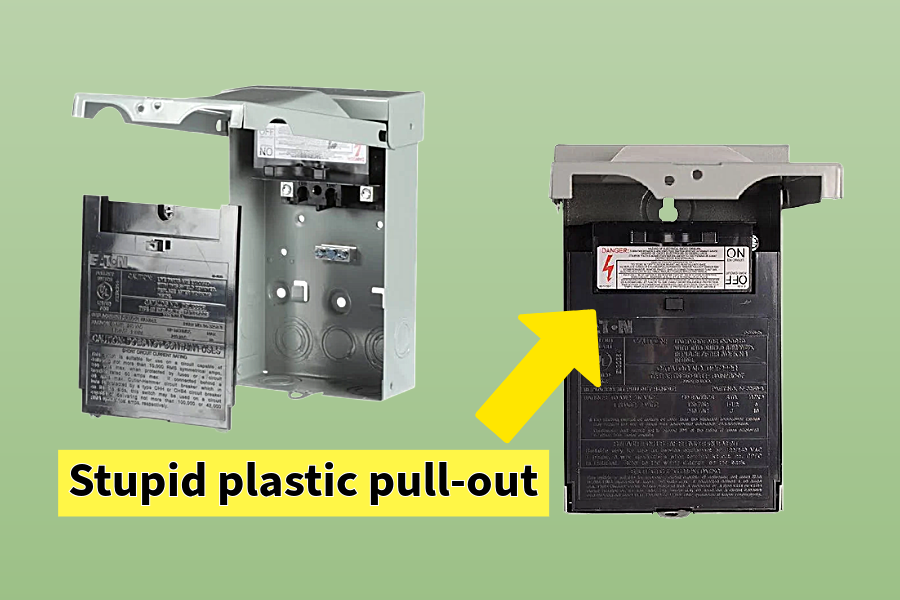
Looking to get out of that hot, cramped attic as quickly as I could, I popped the bottom of the dead front out, allowing me to peek inside the disconnect to quickly verify the condition of the wires. To my surprise, I saw melted plastic everywhere. I realized that a picture was in order and moved to disengage the plastic pull-out handle so that I could gain access to the interior of the equipment.
As they often are, the plastic handle was hard to remove, so I gave it a bit of a tug. Imagine my surprise when the whole thing came apart in my hands, with live 240V wires still precariously connected to the plastic block, which had completely melted and easily pulled out of the metal body of the disconnect.
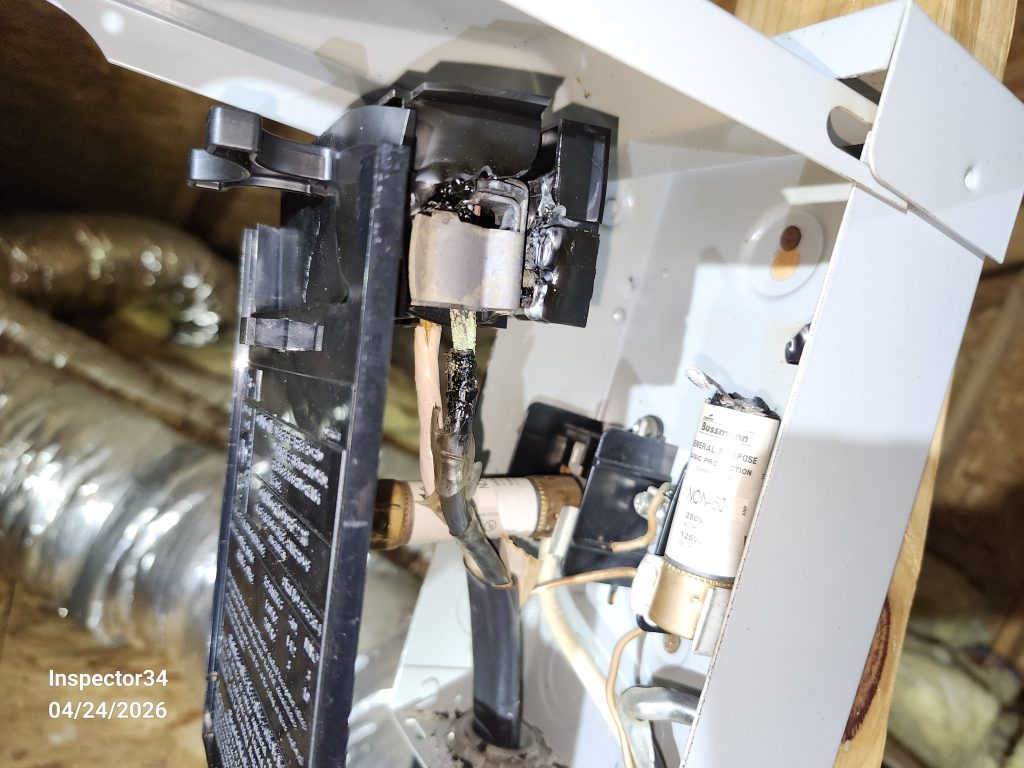
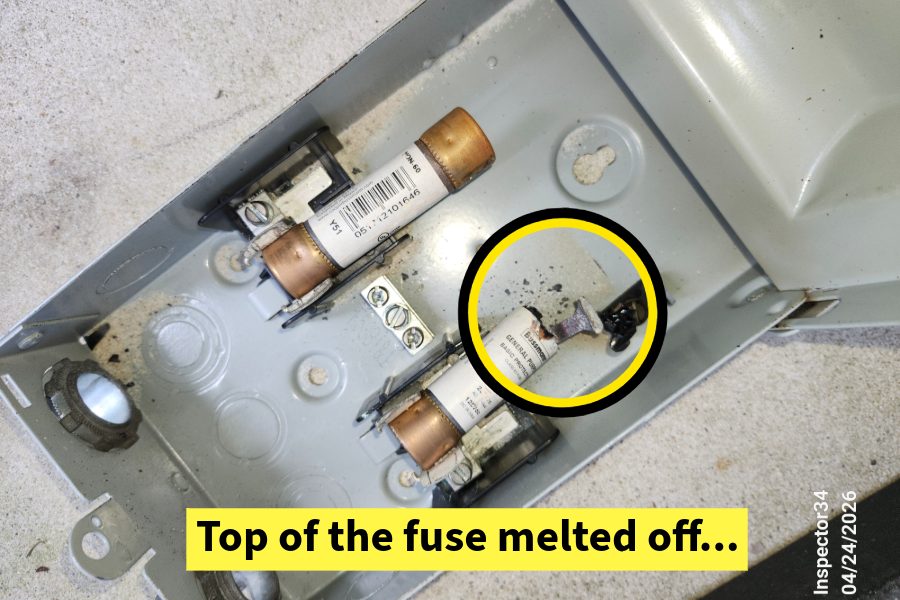
The cooked wires, melted plastic, and completely disintegrated cartridge fuse told the story of a house that’s lucky it didn’t burn down (and an inspector who feels lucky that he didn’t get burned, too). Unfortunately, my hopes for an early start to the weekend seemed to be fading as quickly as I was, standing hunched over a now-not-working air handler at the edge of that hot attic.
The question that every professional home inspector must face at this point is what should we do next. Yes, it’s our job the operate and investigate things during an inspection, and yes, that means that eventually something is going to break as soon as we put our hands on it. We do have standards to follow when we’re inspecting, but there are no guidelines on what we’re supposed to do when something like this happens. Is it my job to fix something like this? Am I supposed to let everyone know what happened and offer to pay for the repairs? Or do I just let them know what happened and wish them good luck? Obviously, this was a problem long before I got there and was not the result of something done during the inspection. But the fact remains that, even though that damaged disconnect was a big fire hazard, the new damage was done by the hand of the home inspector.
Unfortunately, like most everything else in our lives, the answer to the question of responsibility is a firm “maybe.” There is certainly an effective argument to be made that I bear no responsibility whatsoever for this issue, as things like this happen when an inspection is done. There’s always that chance, and it’s simply part of the process. Sorry for your luck. And instead of being pissed at me, you should be thankful that I saved you and your family from experiencing a tragic house fire…
On the other hand, shouldn’t an inspector bear some responsibility when their actions directly caused the damage? This is a difficult situation to find yourself in, and everyone is going to have their own way of dealing with such a problem. An important point to remember is that every situation is unique and there is no one-size-fits-all solution to a home inspection problem. Every house, every buyer, every agent, every seller, and every deal is different, and that fact must be accounted for in our decision-making process.
If this had been a vacant house in need of serious repair, it’s likely that I would have turned off the breaker that fed the disconnect, took some pictures, put all applicable information in the inspection report, and gone on my merry way.
But this wasn’t a house in need of serious repair; it was an occupied house in fairly good shape, which had a functional air conditioner BEFORE the home inspector put his hands on it. Also, this was an agent who had been recently referred to me. I had done a couple of inspections with her and was trying to lock up her business in short order. And to top it all off, I could tell from the pictures around the house, this was a young family with two kids still in diapers. Not exactly the right kind of situation to try to claim innocence and slowly slip away from, into the night.
Given all these parameters and considering that this was a fairly easy repair that I had performed many times over my years in the construction industry, I chose to fix the problem that I caused. I first notified the agent and asked her to contact the listing agent to let them know what had happened and to ask the sellers for authorization to make the repair. Once that was done, I took a short ride to the nearby True Value Hardware store and bought a comparable $20 disconnect. Due to the cramped working space (wedged behind an air handler, bent over underneath the hip of the roof), a five-minute job took about twenty minutes to complete, all the while wiping sweat from my eyes so that I could see what I was doing. Thankfully, the unit started right up when I flipped the breaker.
The agent was pleasantly surprised by my actions, and while I was in the attic of this small home, I’m sure I overheard her talking to a few other agents about the proceedings. It’s quite likely that those conversations are going to turn into some of the best marketing I could ever buy.
Yes, I could have just washed my hands of the situation and walked away, but why would I want to let someone else dictate how this problem played out? I took control of the narrative, spent a minimal amount of money and time, and turned what could have been a dayslong argument into a non-event.
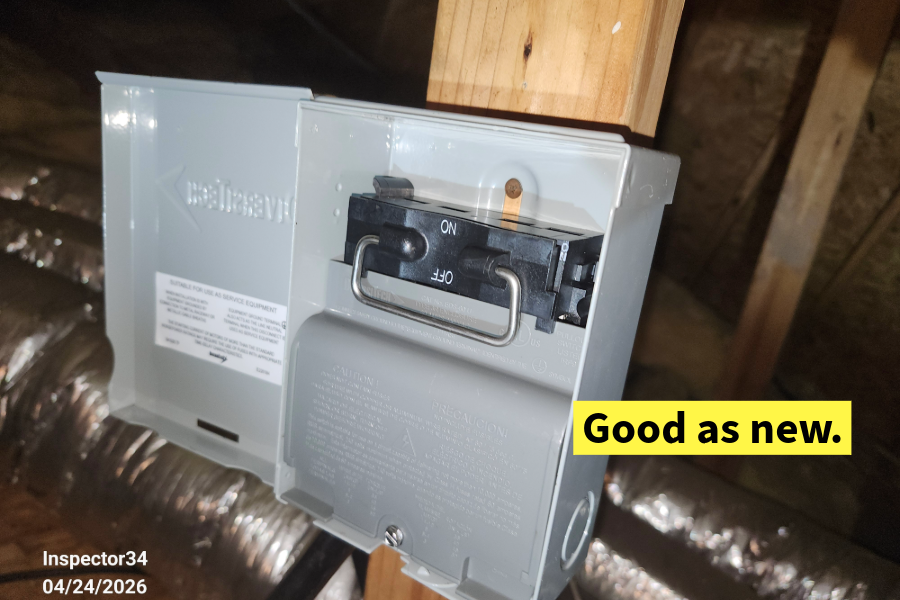
You can bet I included some nice verbiage in that report about the overheating, damage, and subsequent repair. I advised them to have everything evaluated by an electrician, including diagnosing why the problem started, and what needs to be done to prevent a reoccurrence.
And I included a few cool pictures, too.
Just because.
(In a nod to my home inspection insurance company, the proceeding part of the story only took place in my mind. I have not, and will not ever, performed any repairs while performing a home inspection. ?)
Would you like to get an email every Friday where we share the newest things we’ve discovered about home inspections? CLICK HERE to sign up.
Want to be an Influencer in Your Field? Share This Post!
Thanks, Joe